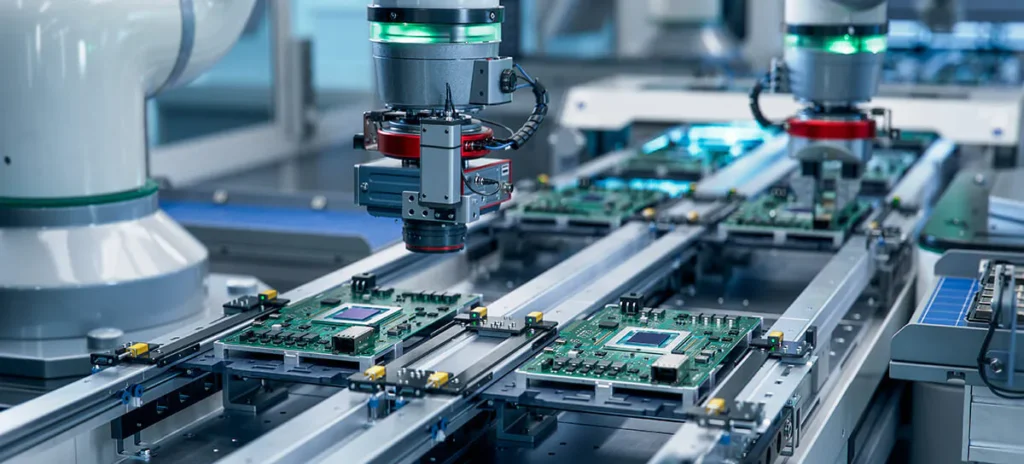
After completing the design of a new device, companies must find a factory for mass manufacturing. Today, outsourcing electronics production to other countries is a common practice. Companies that choose offshore factories can benefit from lower production or shipping costs, deeper expertise of local manufacturers, special export duties, political stability, and other factors. It is highly important to make the right choice from the very beginning because changing locations after the production launch can be quite costly. In this post, we will examine the world’s most popular locations for manufacturing electronics and talk about what you need to launch mass manufacturing.
Preparing for Mass Production
Creating an electronic product starts with development. This task can be completed in-house or outsourced to an electronics development company with expertise in a given field. HHD specializes in developing IoT devices, power electronics, FPGA-based solutions, and other embedded systems for various industries. Contact our team to learn about our experience. After that, you should make sure your product is ready for mass production. Use the following checklist.
- Design for manufacturing and assembly
There is more than one way to make a properly functioning device. However, not all solutions are equally cost-efficient in terms of production. Simply put, the product must be designed in such a way that it is easy and cheap to produce. Professional electronics development companies design products with the manufacturing and technical capabilities of modern factories in mind, which is called ‘Design for Manufacturing and Assembly’.
- Product testing
Products under development undergo various tests at all phases of the process. The same goes for the final product. There are many types of tests designed for different devices. Read our blog post on PCB and electronics testing to learn more. Testing ensures the product meets the functional, non-functional, and certification requirements.
- Certification
Most electronic devices must be certified if you want to sell them. Certification proves that the product meets regulatory requirements and industry standards on safety, environmental protection, noise level, etc. Some certifications are mandatory, while others are voluntary. Learn more in our post on electronics certification in the U.S. and EU. Different countries impose different requirements on electronic devices, depending on their type and field of application. It’s important to obtain all the required certifications before launching mass production because altering the design will require changing the manufacturing process, which will lead to extra expenses.
- PCB design documents
These include the bill of materials (BoM) as well as the PCB schematic and layout. Our team uses Altium Designer and other CAD software for PCB design and layout. The projects created in such software can then be exported as Gerber files used for manufacturing. They describe copper layers, the coordinates of components, vias, and tracks on the board, and other details that factories need.
- Test software
Along with hardware, HHD also develops embedded software for our devices. However, we strongly advise against handing it over to factories for the sake of IP protection. As a safety measure, we create test firmware that only checks if the board’s components are working properly but does not contain any business logic. The team can also develop software for test fixtures that automatically check the work of manufactured PCBAs in factories.
- Documents for enclosure design
These are the documents required to manufacture enclosures for the printed circuit board in a factory. They include a 3D model of the PCBA and assembly drawings if required. Although HHD doesn’t design enclosures, we have reliable partners who can take care of this task.
If the product is tested and certified and you have all the required documents, it’s time to decide whether you want to outsource production to other countries or manufacture the product domestically.